Are YOU Ready for a Rabbit?
Picking the right rabbit
A note on where to find rabbits: if you have decided to add a rabbit to the family, I highly recommend you start out by looking at your local shelter or rabbit rescues. There are lots of rabbits who need a second chance at a forever home.
Where your Rabbit Will Live
Choosing the right kind of cage for your rabbit is extremely important. Cages that are spacious enough, easy to clean, and easy to for your rabbit to get in and out of, will make sharing your home with a rabbit so much easier. A cage that is large enough is important for the well-being of your pet rabbit, but is is no substitute for exercise and social time out of the cage. First off you need to decide if your rabbit will be indoors or outdoors. When deciding you need to pick what would be best for your family and the rabbit.
Every rabbit owner should know that the safest place for a rabbit to live is indoors. Even in a safe enclosure, rabbits are at risk from predators. Merely the sight or sound of a nearby wild animal can cause rabbits so much stress that they can suffer a heart attack and literally die of fear. But that doesn't mean keeping your rabbit outdoors isn't possible.
 |  |
Indoor Rabbits
If kept in a cage, rabbits need a lot of room to easily move around. A rabbit's cage should be a minimum of five times the size of the rabbit. Your rabbit should be able to completely stretch out in his cage and stand up on his hind legs without bumping his head on the top of the cage. Additionally, cages with wire flooring are hard on rabbits' feet, which do not have protective pads like those of dogs and cats. If you place your rabbit in a wire cage, be sure to layer the floor with cardboard or other material. Place a cardboard box or "rabbit condo" in the cage so the bunny has a comfortable place to hide, and respect your animal's need for quiet time (rabbits usually sleep during the day and night, becoming playful at dawn and dusk).
When rabbits are kept in a cage, they need to be let out for several hours each day for exercise. Aside from running and jumping, rabbits also enjoy exploring their surroundings. This is an ideal time to play and interact with your rabbit. Make sure that he has a safe area to play and explore.
Free Roam
Whether you decide to let your rabbit roam free in your entire home or just a limited area, it is important that you make everything rabbit-safe. One little bunny can easily find a whole lot of trouble in an average home. Because rabbits like to chew, make sure that all electrical cords are out of reach and outlets are covered. Chewing through a plugged-in cord can result in severe injury or even death. Their chewing can also result in poisoning if the wrong objects are left in the open or in unlocked low cabinets. Aside from obvious toxins like insecticides, rodenticides, and cleaning supplies, be aware that common plants such as aloe, azalea, Calla lily, Lily of the Valley, philodendron, and assorted plant bulbs can be poisonous to rabbits.
 A free roam room | 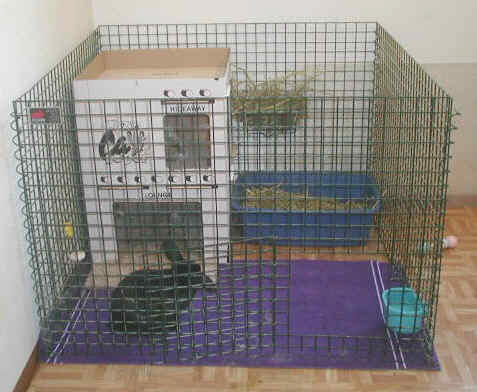 This is what an indoor cage can look like |
Outdoor Rabbits
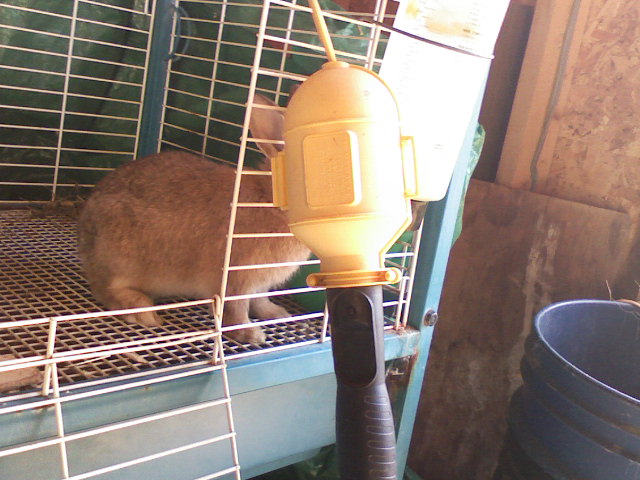 | 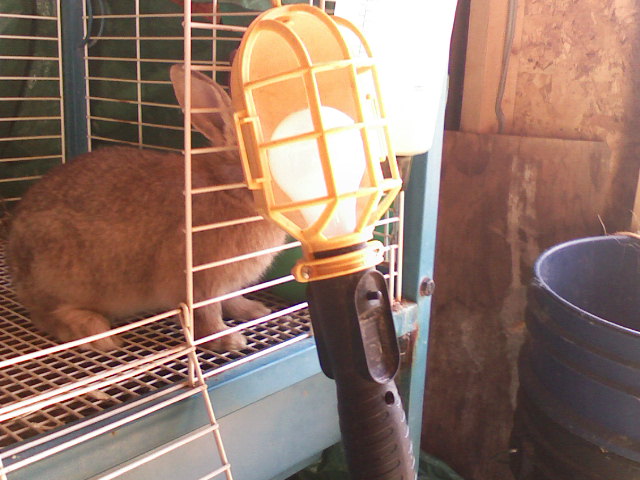 |
This is the heat lamp technique. Shows you how the heat lamp is against the water and also what the heat lamp looks like.
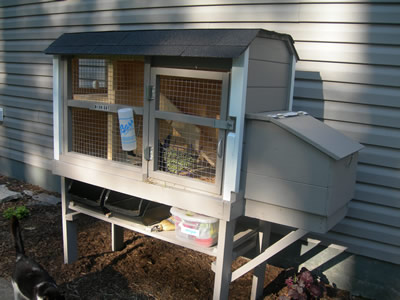 Rabbit Hutch |  Straw in rabbit hutch box |
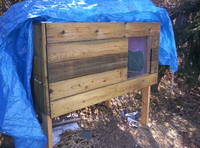 |
<-- This is a rabbit hutch covered by a tarp. Bad example but I'll get you better ones this fall! |
Feeding Your Rabbit
Rabbits have complex digestive systems, so it's very important that they receive a proper diet. Many health problems in rabbits are caused by foods that are incompatible with their digestive physiology. A basic rabbit diet should consist of the following foods:
Hay
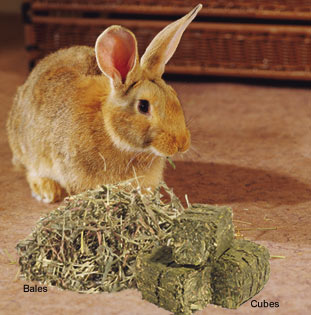
Rabbits need hay—specifically, Timothy grass hay. Rabbits should have access to a constant supply of this hay, which aids their digestive systems and provides the necessary fiber to help prevent health problems such as hair balls, diarrhea, and obesity. Alfalfa hay, on the other hand, should only be given to adult rabbits in very limited quantities, if at all, because it's high in protein, calcium, and calories.
Vegetables
In addition to hay, the basic diet of an adult rabbit should consist of leafy, dark green vegetables such as romaine and leaf lettuces, parsley, cilantro, collard greens, arugula, escarole, endive, dandelion greens, and others. Variety is important, so feed your rabbit three different vegetables at a time. When introducing new veggies to a rabbit's diet, try just one at a time and keep quantities limited.
Fruits and Treats
While hay and vegetables are the basis of a healthy diet, rabbits also enjoy treats. Cartoons and other fictional portrayals of rabbits would lead us to believe that carrots are the basis of a healthy rabbit diet. Many rabbits enjoy carrots, but they are a starchy vegetable and should only be given sparingly as a treat. Other treats your rabbit might enjoy are apples (without stems or seeds), blueberries, papaya, strawberries, pears, peaches, plums, or melon. Extra-sugary fruits like bananas, grapes, and raisins are good too, but should be given on a more limited basis.
Foods to Avoid
With such sensitive digestive systems, there are a number of foods that rabbits should avoid eating. These include iceberg lettuce, tomatoes, cabbage, corn, beans, peas, potatoes, beets, onions, rhubarb, bamboo, seeds, grains, carrots and many others. Also, don't feed your rabbit chocolate, candy, anything moldy, or most human foods. If you are not sure about a certain food, ask your rabbit's veterinarian.
Pellets
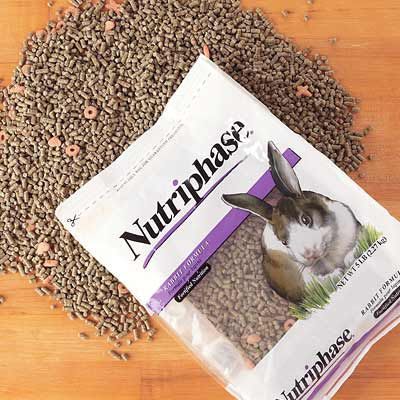
If you choose to make pellets a part of your rabbit's diet, it is best to use them as a supplement to the dark green, leafy vegetables, not as a substitute. These pellets should only be given in small quantities (1/8 -1/4 cup per five pounds of body weight per day, spread out over two daily feedings). Also, make sure to purchase Timothy-based pellets. Many brands of rabbit feed contain seeds, corn, and other foods that are too high in calories to be the basis for a healthy rabbit's diet.
Water
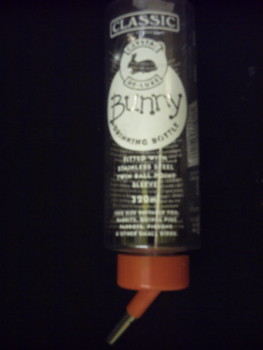
Rabbits should always have an ample supply of fresh water available. Be sure to change your rabbit's water at least once each day. Water can be kept in a sipper bottle or bowl. If you use a sipper bottle, watch new rabbits to make sure they know how to use the bottles, and clean bottles daily so the tubes don't get clogged. If you use a bowl, make sure that the bowl is heavy enough to avoid tipping and spilling.
 |  |
 |  |
Chewing
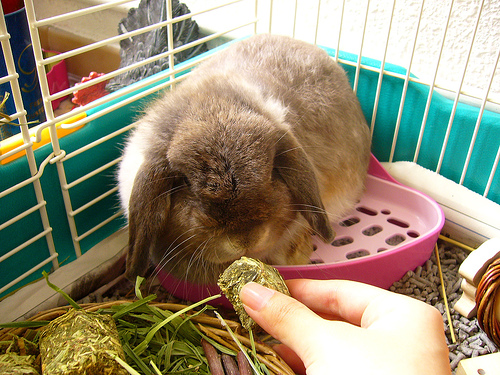
Chewing is part of a rabbit's natural behavior, but it doesn't have to be destructive. To keep rabbits active and amused, you may want to put untreated wood blocks or cardboard in their cages (Be sure to remove any staples or tape from cardboard first!). Bowls, balls, and rings made of willow wood are big hits with many rabbits and can be purchased online or in specialty stores. You can also use paper-towel rolls, toilet-paper rolls, and other chewable cardboard materials that can be tossed in the trash once they've served their purpose. Avoid objects with sharp edges, loose parts, or soft rubber that rabbits could chew into pieces and swallow. I'd suggest the Timothy Hay Blocks! They are great for rabbits to chew on and really easy on their stomachs.
Handle with Care!
Rabbits are fragile animals who must be handled carefully. Their bones are so delicate that the muscles in their powerful hind legs can easily overcome the strength of their skeletons. As a result, if not properly restrained, struggling rabbits can break their own spines.
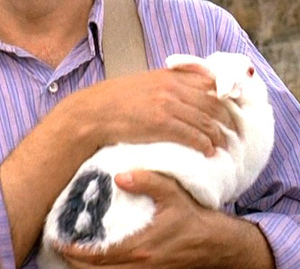
To pick up your rabbit, place one hand underneath the front of the rabbit and the other hand underneath his back side, lifting him carefully with both hands and bringing him against your body. Never let a rabbit's body hang free, never lift by the stomach, and never pick a rabbit up by his ears.
Don't forget that rabbits are prey animals and many will not enjoy being picked up. Be sure to go slowly with your rabbit and practice. Let your rabbit get accustomed to being handled.
Rabbits groom each other around the eyes, ears, top of the nose, top of the head, and down the back, so they'll enjoy it if you pet them on their heads. Like any animal, each rabbit will have an individual preference about where he likes to be touched. Rabbits lack the ability to vomit or cough up hairballs like cats, so try to remove loose fur when you have the opportunity to do so. Simply petting or brushing your rabbit for a few minutes each day should remove most of the excess fur. Some rabbit breeds, such as angoras, have extra grooming needs because of their distinctive coats.